|
| |
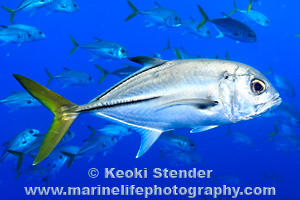
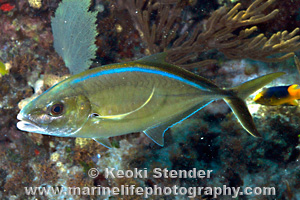
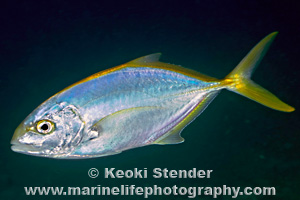
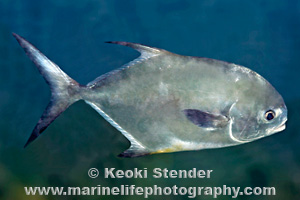
Family Carangidae
Jacks
|
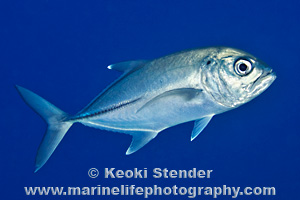
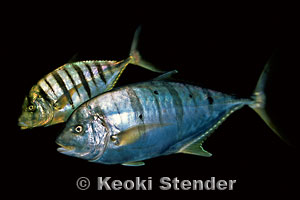
Jacks are compressed silvery fishes with a
pair of dorsal and anal fins, stiff, forked tails and narrow caudal peduncles
often protected by a hard ridge of scales known as scutes. In most species
the first anal fin composed of three short spines is embedded in the skin just
behind the anus.
These fishes are carnivores that may form schools or aggregations
in a wide range of habitats including estuaries, bays, reefs, and the open
sea. Some species will hunt opportunistically by trailing other carnivores
as they forage including eels, sharks, and marine mammals.
Most species are valuable food and sport fishes but large trevallies
have been depleted in most areas due to overfishing. Large Carangids feed
heavily upon reef fishes and are the most-likely carriers of ciguatoxin, which
causes serious illness in mammals if eaten.
Many species have long-lived larvae
and occur around the world in warm and temperate waters.
|
WARM SEAS WORLDWIDE
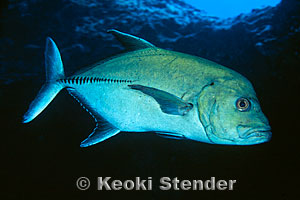
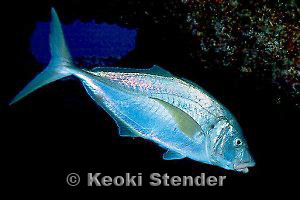
Caranx lugubris
Phoenix, Midway, 50 feet |
|
|
BLACK TREVALLY
|
Uncommon along reef dropoffs. Restricted to deep water
in Hawaii except at Midway. Dark green with concave forehead and black
scutes. Attains 32 inches. Worldwide in warm seas. |

Uraspis helvola
Juvenile, Angel Ledge mooring, Midway
|
Juvenile, Angel Ledge mooring, Midway |
Juvenile, with Thysanostoma jelly, Moku Manu, Oahu |
Juvenile, Chromis mooring, Midway
|
Juvenile, Kona Coast, Hawaii |
Thysanostoma jelly, Kona Coast, Hawaii |
|
|
COTTONMOUTH or WHITEMOUTH JACK
Dobe
|
Adults rarely encountered, preferring deep reefs
below normal diving depths. Juveniles seen with floating objects
or large jellies. Interior of mouth is white. Adults are broadly rounded and dark in
color. Attains 20
inches. Worldwide in warm seas. Uraspis reversa & U.
secunda are synonyms. |

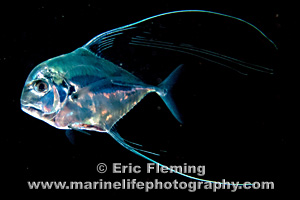
Alectis ciliaris
Portlock, Oahu
|
Portlock, Oahu |
Ko'olina Lagoon, Oahu |
|
THREADFIN JACK ULUA KIHIKIHI
|
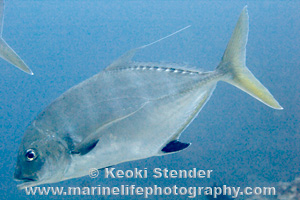
Uncommon over soft bottoms in harbors, bays, and
deeper water. Wedge-shaped body with steep forehead and lacking first
dorsal fin. Juveniles have elongated streamers. Reaches 4.5 feet and 60 pounds.
An excellent food fish. Worldwide in
warm seas. |

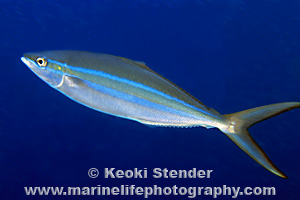
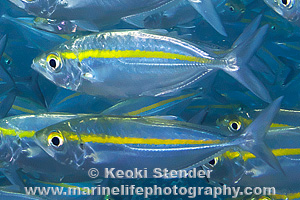
Elagatis bipinnulata
Phoenix, Midway, 50 feet |
|
|
|
|
|
|
|
RAINBOW RUNNER
KAMANU Tsumu-buri
|
Inhabits open water adjacent to reefs and
islands. Uncommon in Hawaii. Green above with blue and yellow stripes, no scutes.
Attains 4 feet. Worldwide in warm seas. |

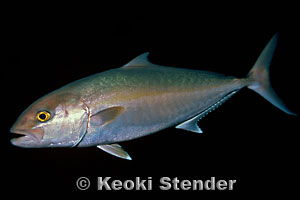
Seriola dumerili
Juvenile, Angel Ledge buoy, Midway
|
Pacific Beach Hotel, Oahu |
Fish Hole, Midway, 40 feet |
|
|
|
GREATER AMBERJACK
KAHALA
Kampachi
|
Common in deep water, often ventures into shallow
water to prey upon fishes. Brown above with yellow lateral stripe and dark
diagonal bar through large eyes. Often causes ciguatera
poisoning. Attains 6 feet and at least 150 pounds. Worldwide in warm seas. |

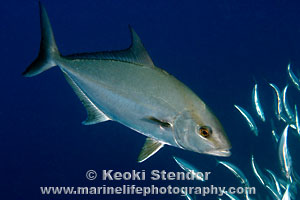
Seriola rivoliana
Cabo Pulmo, Baja California, Mexico, 100 feet |
|
|
|
|
|
|
|
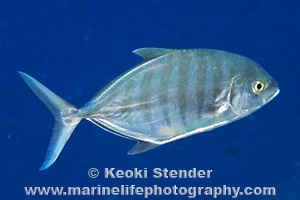
ALMACO JACK Pez Fuerte
| Fairly common in subtropical and warm temperate regions around the
world but vary rare in Hawaii. Body is deeper than S. dumerili
and
second dorsal fin is tall and falcate. Attains 4 feet & 130 pounds. |

Seriola lalandi
Midway Atoll |
Midway Atoll |
|
|
|
|
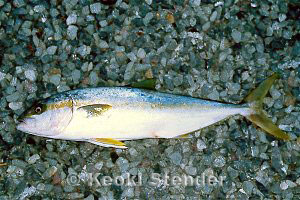
YELLOWTAIL Hiramasa
|
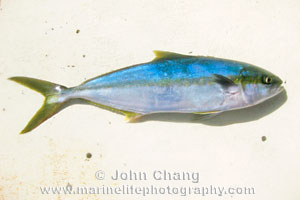
Inhabits coastal waters. Rarely found around
Midway, it is common in continental waters. Green above with yellow lateral stripe and fins.
Scutes absent. Attains at 5 feet & 115 pounds. Excellent
food and game fish. Worldwide in subtropical and warm temperate waters. |

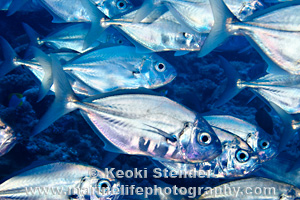
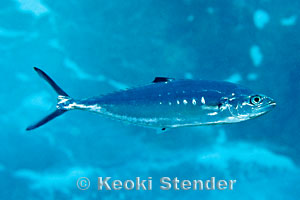
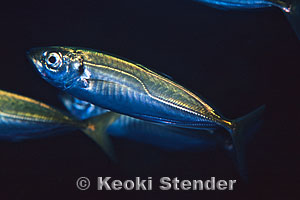
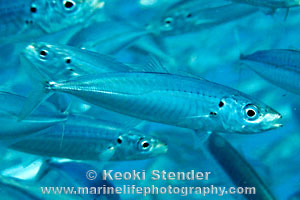
Decapterus macarellus
Kailua-Kona, Hawaii, 20 feet |
|
|
MACKEREL SCAD
'OPELU
Kusayamoro
|
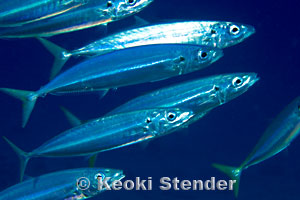
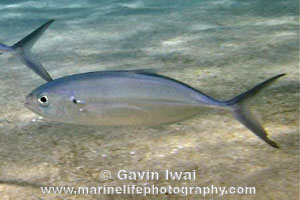
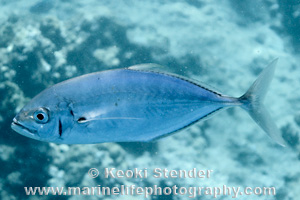
Abundant in coastal waters. Tapering body, pointed snout, dark spot at gill
opening. Feeds upon zooplankton and preyed upon by pelagic
fishes. An important food and bait fish in Hawaii. Attains 12.5 inches.
Worldwide in warm seas. |

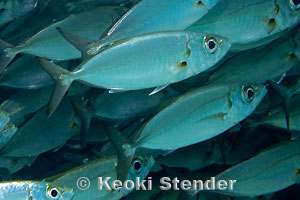
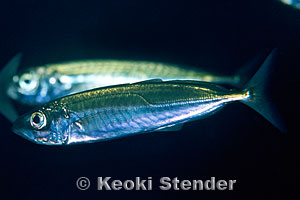
Selar crumenophthalmus
Juvenile, Haleiwa Trench, Oahu, 5 feet
|
Sharks Cove, Oahu, 10 feet |
Pitt Stop, Midway, 15 feet |
Sharks Cove, Oahu, 10 feet |
|
|
BIGEYE SCAD
'AKULE
Meaji
|
Seasonally abundant in quiet bays and coastal
waters. Large eyes, dark spot at gill opening. Feeds upon zooplankton and preyed upon by large jacks
and sharks. An important food fish in Hawaii. Attains 11 inches.
Worldwide in warm seas. |

HAWAII / INDO-PACIFIC
Carangoides ferdau
North Beach, Midway, 10 feet |
Hanauma Bay, Oahu, 10 feet |
|
|
BARRED JACK
|
Uncommon on sandy reefs in small groups.
Faint dark bars on a oval body. Attains 21 inches. Excellent
food fish. Indo-Pacific including Hawaii. |

Carangoides orthogrammus
Moku Manu, Oahu, Pelagic |
Pitt Stop, Midway, 40 feet |
|
|
YELLOWSPOT JACK
|
Uncommon on sandy reefs. Attains 28 inches.
Indo-Pacific & the Tropical Eastern Pacific, including Hawaii. |

Caranx ignobilis
Subadult, Hanauma Bay, Oahu, 4 feet
|
Fish Hole, Midway, 20 feet |
Pitt Stop, Midway, 20 feet
|
Courting male, Pitt Stop, Midway, 20 feet |
Pitt Stop, Midway, 20 feet
|
Pearl & Hermes Reef, NWHI, 10 feet |
Gardner Pinnacles, NWHI, 25 feet |
GIANT TREVALLY
ULUA
AUKEA Ronin-aji
|
Quite rare in areas with fishing activity, it is the
dominant species in terms of biomass in the Northwestern Hawaiian
Islands except Midway where the population was depleted due to sport
fishing. Courting males may appear black. Attains at least 5 feet and 150 pounds.
Often causes ciguatera poisoning. Indo-Pacific including Hawaii. |

Caranx melampygus
Hanauma Bay, Oahu, 5 feet
|
Hanauma Bay, Oahu, 25 feet |
Opportunistic hunting, Sharks Cove, Oahu |
|
|
|
|
BLUEFIN TREVALLY
'OMILU
Kasumi-aji
|
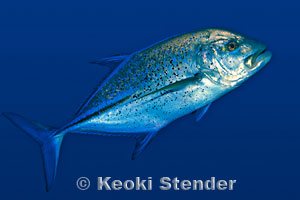
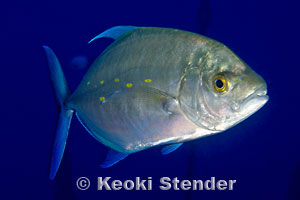
Most common trevally in nearshore waters. Blue fins and spots on body, pectoral fins yellow.
Attains 39 inches and 100 pounds. Excellent food fish but larger
ones may cause ciguatera poisoning. Indo-Pacific & Tropical Eastern Pacific
including Hawaii. |

Caranx sexfasciatus
Pacific Beach Hotel, Oahu |
|
|
|
|
|
|
BIGEYE JACK
Gingame-aji
|
Schooling young found in protected areas, adults are
rare. Nocturnal reef predator. Elongate body, large eyes, black spot at upper edge of
gill opening, white fin tips. Attains 33 inches. Less palatable
than other species. Indo-Pacific & Tropical Eastern Pacific
including Hawaii. |

Pseudocaranx cheilio
Juvenile, Fish Hole, Midway, 30 feet
|
Juveniles, Fish Hole, Midway, 30 feet |
Phoenix, Midway, 50 feet |
|
|
|
THICKLIPPED JACK
BUTAGUCHI or LEHE Shima-aji
| Rarely seen at diving depths except in the Northwestern Hawaiian
Islands where it is locally common. Attains 32 inches and 40
pounds. Excellent food fish with high fat content. Hawaii
and possibly Easter Island. Formerly known as P. dentex, an
Atlantic species. |

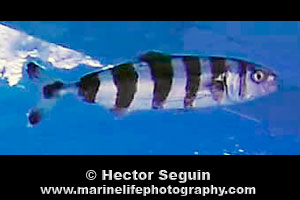
Gnathanodon speciosus
Pacific Beach Hotel, Oahu
|
Pacific Beach Hotel, Oahu |
|
|
|
YELLOW TREVALLY
ULUA
PA'OPA'O
|
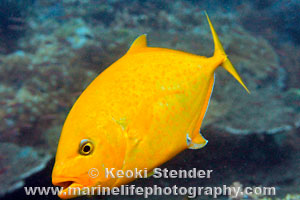
Uncommon over sand or mud in bays and harbors. Juveniles are bright yellow with bold black bars,
adults become pale and acquire black blotches, lips thick and toothless.
Feeds upon buried shellfish. Attains 4 feet. Excellent food
fish. Indo-Pacific, tropical Eastern Pacific & Hawaii. |

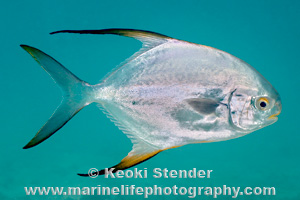
Scomberoides lysan
Hanauma Bay, Oahu, 10 feet
|
Hanauma Bay, Oahu, 10 feet |
Maui |
|
LEATHERSKIN
LAI
|
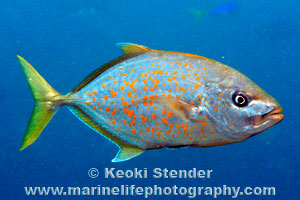
Fairly common in the water column near reefs. Shiny,
leathery skin with bright spots and black tipped dorsal
fin and dark caudal fin lobes. Scutes absent. Fin spines are
venomous. Attains 27 inches. Dried skin used in fishing
lures. Indo-Pacific including Hawaii. |

JAPAN
Trachurus
japonicus
Yawatano, Izu, Japan, 20 feet |
|
|
|
|
|
|
JAPANESE JACK MACKEREL or SCAD Aji
| Common schooling fish that is commercially important. Attains 19
inches & lives up to 12 years. China, Japan & Korea. |
EASTERN PACIFIC Trachurus symmetricus
Rock Quarry, Catalina Island, California, 10 feet |
|
|
|
|
|
|
|
PACIFIC JACK MACKEREL
| Common schooling fish from Southeast Alaska to Outer Baja
California. Attains 32 inches. |

WESTERN ATLANTIC
Carangoides crysos
Grand Bahama, 45 feet |
|
|
|
|
|
|
|
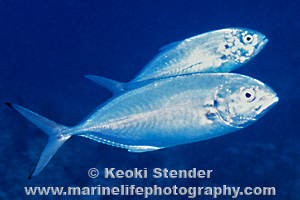
BLUE RUNNER
|
Inhabits coastal waters, schools sometimes
encountered on reefs. Tips of caudal fin are black, small black
mark on upper gill cover. Attains 23 inches. An excellent
food fish. Nova Scotia to Bermuda & Brazil. |

Caranx latus
Grand Bahama, 45 feet |
|
|
|
|
|
|
|
HORSE-EYE TREVALLY
|
Inhabits coastal waters and reefs in small
aggregations. Caudal fin is yellow. Attains 30 inches.
New Jersey to Bermuda and Brazil. |
|