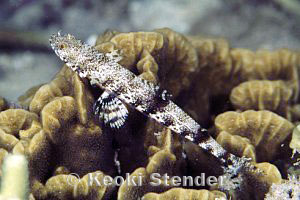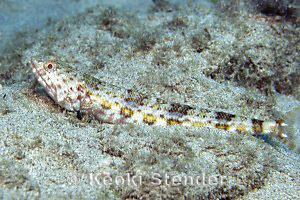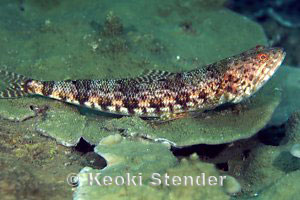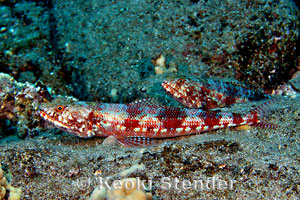
Family Synodontidae

Lizardfishes


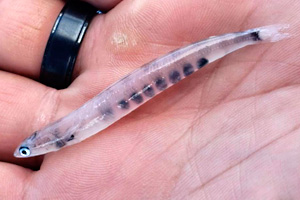
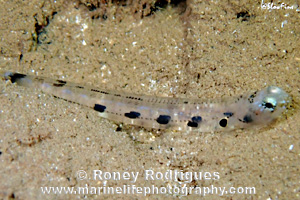
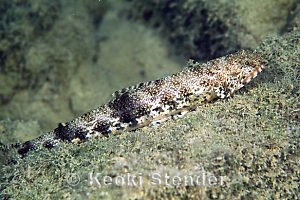
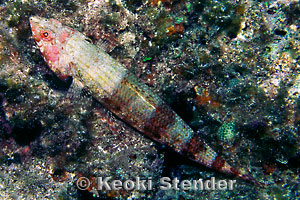
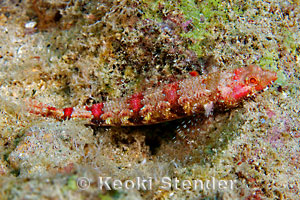
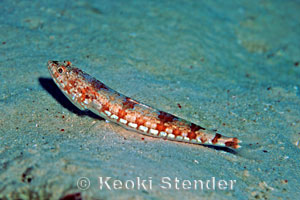
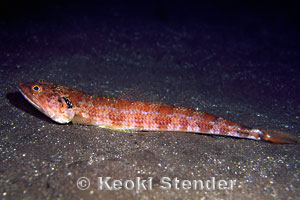
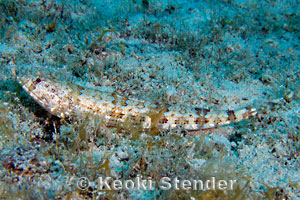
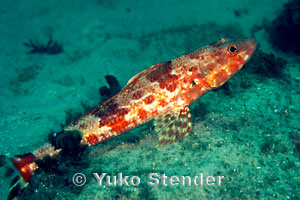
Lizardfishes are known as 'Ulae in Hawaiian and Eso in Japanese.  Most are difficult to identify without considerable experience and color morphs make it even worse.  Saurida are easily distinguished by their tightly-packed bristle-like teeth on the lips.  Synodus have 'normal' conical teeth with gaps between them and Trachinocephalus has eyes set high and far forward allowing it to remain buried with only the eyes exposed.  All lunge rapidly into the water column to capture fishes.  These primitive fishes have a small spineless dorsal fin and stubby adipose fin (small flap of skin) on the caudal peduncle just like salmon.  Lizardfishes are very bony and poor for eating.  Large individuals will reach 1 foot in length.


HAWAII

Saurida flamma

Cargo pier, Midway Atoll, 30 feet

Puako, Hawaii, 30 feet

 ORANGEMOUTH LIZARDFISH

Uncommon among coral reefs.  Mouth full of bristle-like teeth with alternating orange bars.  Reaches 13 inches.  Hawaii, Johnston Island, Pitcairn, Austral Islands, and Rapa.

Saurida gracilis

Cargo pier, Midway Atoll, 30 feet


Kaka'ako, Oahu, 50 feet

Cargo pier, Midway Atoll, 30 feet

Maeda Point, Okinawa, 30 feet

  SLENDER LIZARDFISH

Common in areas of rubble, sand, or silt.  Mouth full of bristle-like teeth with alternating brown bars.  Attains nearly 1 foot.  Tips of pectoral fins 2-3 scale rows ahead of origin of dorsal fin.  Hawaii & the Indo-Pacific.

Saurida nebulosa

Nu'uuli, American Samoa, 5 feet

NEBULOUS LIZARDFISH

Very similar to the Slender Lizardfish.  Tip of pectoral fins 4-6 scale rows ahead of origin of dorsal fin.  Lives in areas of sand and silt.  Attains 8 inches.  Maldives to Hawaii and Tahiti.

Synodus binotatus

Macaw Wreck, Midway Atoll, 30 feet


Hanauma Bay, Oahu, 20 feet

Firehouse, Oahu, 25 feet

Firehouse, Oahu, 25 feet

 TWOSPOT LIZARDFISH

Slender species with 5 greenish brown saddles.  Front 1/3 of body is light.  Often seen resting upon coral branches.  Despite its name most Synodus have two small dots on the snout tip.  Reaches about 7 inches.  Hawaii & the Indo-Pacific.

Synodus dermatogenys

Waianae, Oahu, 40 feet


Kahe Point, Oahu, 25 feet

Sharks Cove, Oahu, 35 feet

Kewalo, Oahu, 90 feet

 CLEARFIN LIZARDFISH

Frequent on sandy reefs.  Mottled light brown with pale blue lateral stripe.  Very similar to the Brown Lizardfish but lighter in color and less robust.  Reaches about 9 inches.  Hawaii & the indo-Pacific.

Synodus ulae

Haleiwa Trench, Oahu, 50 feet


Macaw Wreck, Midway Atoll, 25 feet

Keoki's Ledge, Midway Atoll, 30 feet


Pearl & Hermes Reef, NWHI, 20 feet

Sea Cave, Oahu, 50 feet

  BROWN LIZARDFISH

Most common member of genus on mixed bottom.  Large head and robust body.  Irregular brown markings on light background.  Reaches at least 13 inches.  Hawaii, Japan, and Taiwan.

Synodus variegatus

Ke'ei, Hawaii, 40 feet


Pupukea, Oahu, 40 feet

Kewalo Pipe, Oahu, 50 feet

Kewalo Pipe, Oahu, 50 feet


Kewalo Pipe, Oahu, 50 feet

Kewalo Pipe, Oahu, 50 feet


VARIEGATED LIZARDFISH

Common on reefs, often in pairs.  Reddish or greenish brown with lateral stripe of dark blotches.  Smaller and less robust than the Brown Lizardfish.  Five dark saddles on back.  Reaches about 10 inches.  Hawaii & the indo-Pacific.

Trachinocephalus myops

Kailua-Kona, Hawaii, 60 feet


Osezaki, Japan, 40 feet

Juvenile, Makua, Oahu, 30 feet

Juvenile, Makua, Oahu, 30 feet

 BLUESTRIPE LIZARDFISH

Rare on sand in deeper water.  Several blue stripes on body.  Eyes set high and far forward, head blunt.  Reaches about 13 inches.  Common in Japan.  Circumtropical.


INDO-PACIFIC

Synodus jaculum

Juvenile, Wakatobi, Indonesia, 25 feet

Wakatobi, Indonesia, 30 feet

JAVELINFISH

Common throughout the Indo-Pacific except Hawaii.  Attains 8 inches.


JAPAN

Synodus hoshinonis

Osezaki, Japan, 40 feet

HOSHINO'S LIZARDFISH 

Uncommon on sand at scuba depths.  Japan, Taiwan.

Text and photographs are copyrighted property of Keoki and Yuko Stender unless otherwise indicated.  No part of this website may be used without permission of the authors.  Images may not be used for any purpose without express permission of the photographers.