Family Antipathariidae

Black & Wire Corals

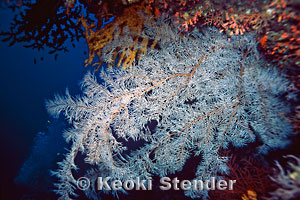
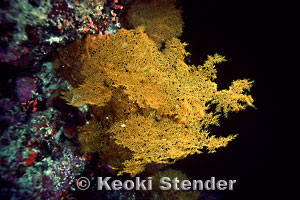
Antipatharians are tree-like or stick-like cnidarians with a solid dark brown skeleton decorated with small spines or knobs.    This rough surface distinguishes it from gorgonians and arborescent hydroids, which are nearly absent in shallow Hawaiian waters.   Colonies occur along current-swept drop-offs and under ledges.  Live colonies may be  rusty brown, orange, yellow, green, or white due to color of the polyps.  They may also fluoresce; this color is not recorded when a flash photograph is taken.  Antipatharians provide food or shelter to many forms of marine life, including fishes, mollusks, and crustaceans.    Many Hawaiian Antipatharians are restricted to very deep water only visited by research submersibles.  It is illegal to collect coral, including Antipatharians, without a special permit.  Here are four species scuba divers may encounter. 


HAWAII

Antipathes grandis

Molokini Back Wall, 90 feet

Moku Manu Pinnacle, Oahu, 130 feet

  GRAND BLACK CORAL

Two species of precious black coral are found at scuba diving depths in Hawai'i.  Both were harvested extensively for the jewelry trade; a few large colonies may be found in remote locations.  Both are very similar to the untrained observer. 

Antipathes grandis was harvested extensively for the jewelry trade and is rare today.  It normally occurs in water deeper than 150 feet.  It has flexible branches as thin as 0.3mm in diameter, and 12 polyps per cm.  It is endemic to Hawaii.

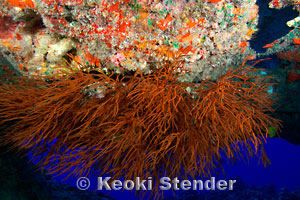
Antipathes arborea

Moku Manu Pinnacle, Oahu, 140 feet


Portlock Point, Oahu, 25 feet

Baby Barge, Oahu, 65 feet


Baby Barge, Oahu, 65 feet

Baby Barge, Oahu, 65 feet

   BRANCHING BLACK CORAL

Formerly known as Antipathes dichotoma (a Mediterranean species) this coral is found as shallow as 15 feet.  The stiff, vertically pointing branches may be as little as 0.6mm in diameter.  There are about 8 polyps per cm. 

Rare fishes are associated with Antipathes.  The Longnose Hawkfish perches itself among the branches, making it difficult to photograph.  Tinker's Butterflyfish is not directly associated with black coral, but frequents the same habitat.

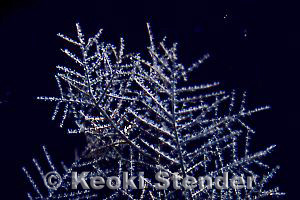
Antipathes intermedia

Chromis, Midway, 40 feet

Chromis, Midway, 40 feet


SMALL FEATHERY BLACK CORAL

Rare in dark crevices from 20 to 40 feet at Midway, normally deeper than 600 feet elsewhere in the Hawaiian Islands.  Colonies are about 5 inches tall with branches less than 2mm in diameter.

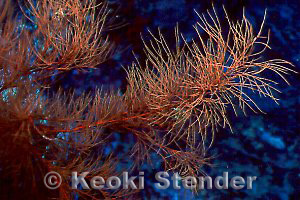
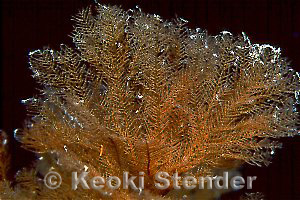
Myriopathes cf. japonica

Moku Manu Pinnacle, Oahu, 100 feet

Moku Manu Pinnacle, Oahu, 100 feet

 DENSE FEATHERY BLACK CORAL

This shrubby little species has pinnate, or feather-like, branches that form broad plates several layers deep.  It is a rare species, but is quite prolific where it occurs.  It's branches are too small to be used for jewelry. 

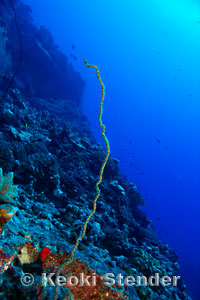
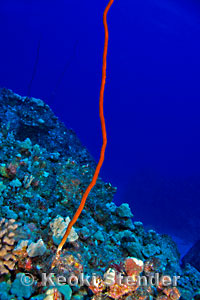
Cirrhipathes anguina

Wire Coral Shrimps, Haleiwa Harbor, 25 feet

Wire Coral Goby, Haleiwa Harbor, 25 feet


Lanai Lookout, Oahu, 50 feet

Honaunau, Hawaii, 140 feet


Haleiwa Trench, Oahu, 30 feet


Maui Ocean Center


YO-257 wreck, Oahu, 90 feet

   WIRE CORAL

These odd stick-like wire corals are commonly found protruding from vertical cliffs or attached to rocky outcrops in deeper water exposed to current.  Large colonies may be as long as 5 feet; most are less than 3 feet.  It will fluoresce neon green but this color is rarely captured on film.

The most common animal associated with it is the goby Bryaninops yongei.  A pair of gobies will remove living tissue off the wire coral and deposit their eggs.  This dead area often leads to the decline or fragmentation of the host.  Under certain conditions, the fragment will be able to re-attach itself to the reef and grow into a new colony.

A tiny shrimp called Pontonides also inhabits wire corals, but is extremely difficult to spot when the coral polyps are extended.  These close-up photographs were taken of a single wire coral that had 2 gobies and over 15 shrimp in residence, not a common occurrence.


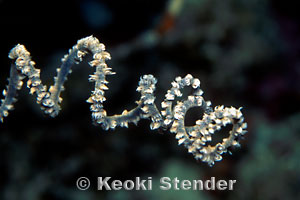
Cirrhipathes spiralis

SPIRAL WIRE CORAL

Rare in Hawaii in deep water but common in the Indo-Pacific along ledges and wrecks.

Stichopathes sp.

WIRE CORAL

Reddish brown with polyps restricted to one side.  Up to at least 4 feet long and not common.

Text and photographs are copyrighted property of Keoki and Yuko Stender unless otherwise indicated.  No part of this website may be used without permission of the authors.  Images may not be used for any purpose without express permission of the photographers.