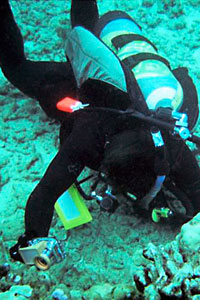
| Most folks will be happy with a compact P&S
camera, combining portability and affordability. In general,
long-time Japanese camera brands are the best choice for
performance and housing options, but make sure to research whether or
not a compatible housing is available. Touch-screen cameras won't
allow much control in a housing, so avoid those. Superzoom models
tend to have a large lens making housings either impractical or the lens
port severely obstructs the built-in flash. Cameras with a 3 or 4x
zoom are ideal. Canon, Olympus, Sony, and Casio sell
housings for some but not all current models. These are ideal in terms of
size, cost, and access to most camera functions. Price of a decent camera and housing should be
somewhere between $400 - $700 dollars. In the USA Ikelite builds housings for
a wide range of current models and expanded options for an external flash and
wide conversion lenses.
P&S cameras are especially good for
close-ups of stationary or slow-moving subjects, some cameras able to
produce nearly life size magnification while maintaining a comfortable
working distance between 3 - 5 inches from the lens. Macro
capability with flash varies so I recommend you try out a few models
before buying.
Using the
built-in lens and flash, these cameras are poor to good for normal and wide
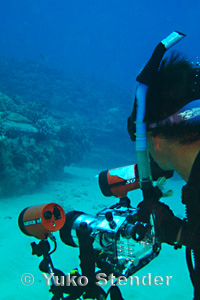
scenes. Some housings accommodate add-on lenses and flash for
better wide-angle performance at considerable cost. Because the
flash is so close to the lens, backscatter or light reflected by
particles in the water, are a major problem.
In general, images taken with even the best
P&S camera are just marginally acceptable for publication. This is due to
physical limitations of tiny lenses and image sensors when compared to
DSLR's of identical megapixel (Mp) rating. Reduced sharpness,
optical aberrations, and noise are problems apparent with most P&S
images. However these shortcomings are not obvious to the
untrained eye and most users will be satisfied with their work. ILC
cameras are a recent introduction with image quality on-par with DSLR's
and prices to match. Unfortunately just a few models are supported
with underwater housings. As this market segment grows there will
undoubtedly be more options available. The biggest advantage of
the ILC format is full-time rapid autofocus while shooting video, a
feature only available with Sony DSLR's with a transparent mirror. |