Phylum Mollusca

Opisthobranchs

Order Anaspida

SEA HARES

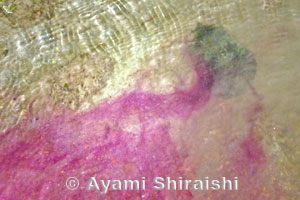
Hawaii has many types of opisthobranchs some of which are undescribed species.  Some of these will go through population surges, abundant one year and absent another, or seasonal appearances.  Most live less than a year and will be found near the specific food they eat.  Food includes seaweeds and a wide assortment of small invertebrates such as sponges, cnidarians, and mollusks.  Slugs that feed upon green seaweed often store algal cells in their mantle for photosynthesis.  Sea Hares produce a purple ink from red algae when disturbed.  Others may produce toxic compounds from food or store stinging cells in the body as defense against predators.  Good places to find them are under stones in the intertidal zone and shady walls and caverns in deeper water.  As with many invertebrates more will be seen at night.
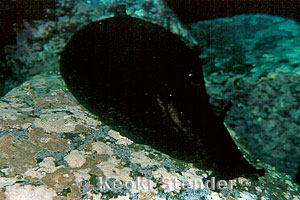
Sea hares have plump bodies with two sets of parapodia on the head.  The mantle is split laterally forming an opening for respiration.  They feed upon red algae and exude a noxious purple dye when disturbed.  Populations are dynamic, abundant some years and absent in others.  They are hermaphroditic and may form mating chains of many animals.


HAWAII

Family Aplysiidae

Aplysia dactylomela

Makapu'u tidepool, Oahu


Makapu'u tidepool, Oahu

Makapu'u tidepool, Oahu

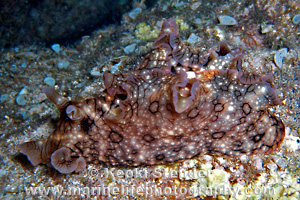
WHITE-SPECKLED SEA HARE

Brown with cloudy white markings and large black rings.  Common on shallow reef flats.  Attains 8 inches.  Worldwide in warm & temperate seas.

Aplysia juliana

Laysan Island, NWHI, 4 feet

EYED SEA HARE

Uncommon on reefs in shallow water.  Posterior end of body forms a sucker-like disc.  About 8 inches.  Worldwide in warm seas.

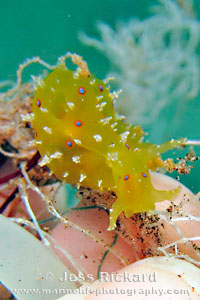
Aplysia oculifera

Diamond Head, Oahu, intertidal

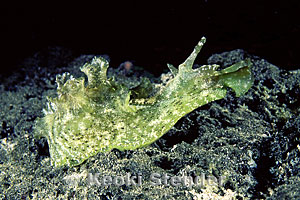
EYED SEA HARE

Rare under stones in shallow water.  Green with white mottling and white dots ringed with black.  Reaches 3 inches.  Hawaii & the Indo-West Pacific.

Aplysia parvula

Angel Ledge, Midway Atoll, 75 feet

Makapu'u tidepool, Oahu

SMALL SEA HARE

Brown to black with light margins, quite variable.  Locally abundant on seaweed.  Less than 1 inch.  Worldwide in warm and temperate seas.

Dolabella auricularia

Midway Harbor, 15 feet

Eared Sea Hare, Midway Harbor, 10 feet, 90mm

Midway Harbor, 15 feet

EARED SEA HARE

Giant warty sea hare seen at night in shallow water.  Posterior of body appears as if cut-off at an angle.  Reaches at least 10 inches when extended.  Eggs look like a mass of tangled spaghetti.  Hawaii & the Indo-Pacific.

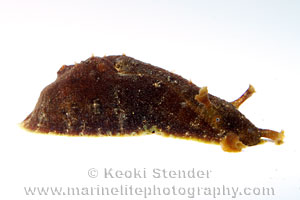
Dolabrifera dolabrifera

Kaloko, Oahu, 1 foot

COMMON SEA HARE

Common under rocks in shallow water and tidepools.  Foot is broad and spreads over the substrate.  About 2 inches.  Warm seas around the world.

Stylocheilus striatus

Kaunolu Point tidepool, Lana'i


Makapu'u tidepool, Oahu

Makapu'u tidepool, Oahu


Makapu'u tidepool, Oahu

Kewalo, Oahu, 80 feet

Kewalo, Oahu, 80 feet

LINED SEA HARE

Seasonally abundant on algae or sand.  Brown with fine black lines and neon blue ocelli; body covered with papillae.  About 2 to 3 inches long.  Feeds upon blue-green algae.  Warm seas around the world.

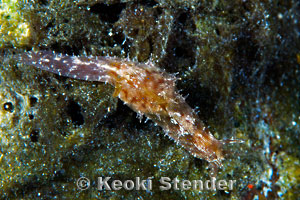
Stylocheilus longicauda

Anglers Reef, Hawaii Kai, Oahu

PELAGIC SEA HARE

Inhabits floating brown algae Sargassum in warm waters around the world but rarely seen near shore.  About 2 to 3 inches long.  Formerly known as S. citrina.


EASTERN PACIFIC


Aplysia californica   

Long Point, Catalina, California, 20 feet

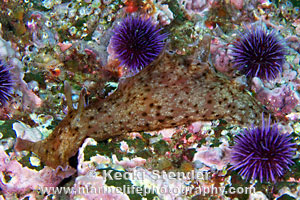
CALIFORNIA SEA HARE

Common in shallow water.  Up to 14 inches.  Baja California to Oregon.

Aplysia vaccaria   

Rock Quarry, Catalina, California, 20 feet

Rock Quarry, Catalina, California, 20 feet

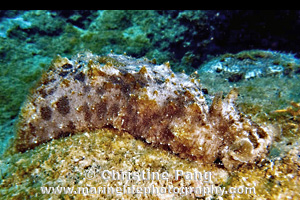
GIANT SEA HARE

Uncommon in shallow water.  The largest gastropod in the world, up to 3 feet long and 30 pounds.  Baja California to Monterey Bay.

Text and photographs are copyrighted property of Keoki and Yuko Stender unless otherwise indicated.  No part of this website may be used without permission of the authors.  Images may not be used for any purpose without express permission of the photographers.