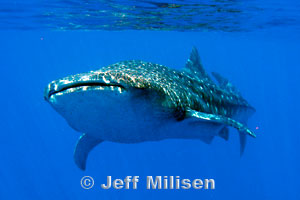
| Many shark species occur in Hawai‘i but few inhabit shallow reefs
where they may be observed by divers with any regularity. They
move through the water gracefully and are an impressive sight not easily
forgotten. Encounters are usually brief as sharks are cautious and
prefer to flee rather than be confronted by a large unfamiliar
creature. They play an important role as apex predators that help
maintain balance in marine ecosystems. Unfortunately sharks
worldwide have been over-exploited and are much more difficult to find.
Sharks are primitive fishes with cartilaginous skeletons instead of
bone. Most give birth to fully-developed young, few lay eggs on
the seafloor. The jaws are lined with rows of developing teeth
behind those in use for quick replacement. The tough leathery skin
is protected by tiny scales called denticles with the same structure as
teeth. Shark senses are bolstered by electro-reception, a system
that detects electrical fields produced by animals. This system
incorporates a network of gel-filled pits on the head called the ampullae
of Lorenzini. Rays and skates are basically sharks with bodies
designed for their role.
Contrary to popular belief, shark attacks are extremely rare and
usually survivable. Most are the result of the animal mistaking a
person as prey under conditions where positive identification is
difficult. This risk is minimized by swimming slowly and calmly
with a buddy in clear water during the day, and avoiding areas where
prey congregate such as harbors and rivermouths. |