|
| |
Family Priacanthidae
Bigeyes
|
Bigeyes may be distinguished from
Soldierfishes by their tiny scales and unforked caudal fin. The dorsal fin
is also continuous. Bigeyes are also much slower in habit and tend to
stare at divers and stay put. They are nocturnal animals that feed upon
zooplankton. |
TROPICAL SEAS WORLDWIDE
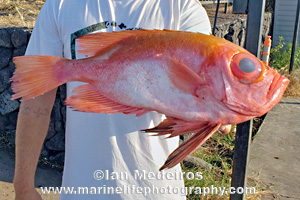
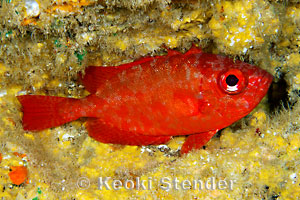
Heteropriacanthus cruentatus
Day coloration, Cabo San Lucas, Baja California, 30 feet
|
Night coloration, Cargo Pier, Midway Atoll, 20 feet |
| Common name |
GLASSEYE |
| Hawaiian |
'Aweoweo |
| Japanese |
Gomahire-kintoki-dai |
| Mexican |
Catalufa de roca |
|
|
| Habitat |
Coral reefs and rocky substrates; in holes during the day |
| Depth |
15 to 300 feet |
| Diet |
Cephalopods, crustaceans, small fish, and polychaetes |
| Size |
10 to 17 inches |
| Abundance |
Fairly common |
| Distribution |
Worldwide in warm seas |
| Notes |
Night coloration is mottled; caudal fin margin is convex; soft fin
rays spotted |

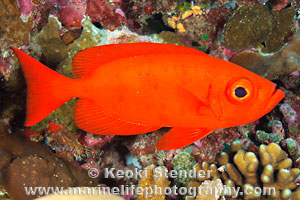
HAWAII Priacanthus meeki
Juveniles, Cargo Pier,
Midway Atoll, 20 feet
|
Day coloration, Fish Hole, Midway Atoll, 40 feet |
Night coloration, Fish Hole, Midway Atoll, 40 feet
|
|
| Common name |
HAWAIIAN
BIGEYE |
| Hawaiian name |
'Aweoweo |
|
|
| Habitat |
Reefs and ledges, hides in holes during the day |
| Depth |
10 to 165 feet |
| Diet |
Large zooplankton |
| Size |
13 inches |
| Abundance |
Uncommon alone or in small groups; abundant some years |
| Distribution |
Endemic to the Hawaiian Islands |
| Notes |
Large settlement of juveniles in summer of 2003;
fins not spotted, caudal fin margin slightly concave |

INDO-PACIFIC
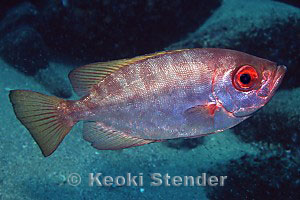
Priacanthus hamrur
Wakatobi, Indonesia |
|
|
|
|
|
|
|
| Common name |
CRESCENT-TAIL BIGEYE |
| Japanese name |
Kintokidai |
|
|
| Habitat |
Reef pinnacles and dropoffs |
| Depth |
20 to 800 feet |
| Diet |
Large zooplankton |
| Size |
16 inches |
| Abundance |
Uncommon |
| Distribution |
Indo-Pacific, except Hawaii |
| Notes |
Often forms aggregations as it rests during the day |

|